Drowning can happen at any time. Drowning occurs not only in large bodies of water such as oceans, lakes, rivers, and streams but also in shallow bodies of water such as buckets and aquariums. Rescuing and bringing victims to shore poses many risks for both the rescuer and the victim. Every year, it is not difficult to see the media reporting on incidents where relatives, friends, and bystanders tried to save victims with the result that many people drowned at the same time.
Bringing a drowning person to shore following safe methods and principles not only helps ensure the rescuer’s safety but also improves the victim’s chances of survival. The following knowledge is presented by Australian Lifesaving Expert Tony Coffey – Co-founder of SSVN Survival Skills and instructor of Surf Life Saving Services.
1. Early identification of signs of drowning
Early identification of signs of drowning makes rescuing the victim easier. The victim can cooperate with the rescuer to get to shore and the possibility of health consequences is also lower, such as brain death. , water in the lungs, etc. This sign can occur as little as 1 minute before the victim sinks into the water.
Delayed recognition of signs of drowning, especially after the victim has sunk into the water, makes rescue work difficult, such as difficulty in locating the victim and making it more difficult to bring the victim to shore. At the same time, within 3-4 minutes from the moment the victim stops breathing, the brain becomes deprived of oxygen and begins to die. Even if the victim is saved, the sequelae of brain damage can last until the end of life. After about 8 minutes, the victim could die completely if not brought ashore promptly and given first aid.
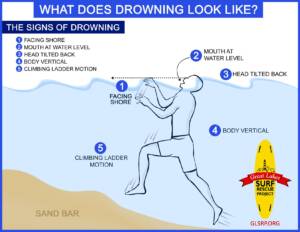
The ‘escalating’ position of a drowning victim.
However, signs of drowning are difficult to detect and require extreme vigilance such as:
Drowning usually happens very quickly, the victim can sink below the water’s surface within about 1 minute.
Drowning victims often struggle in a ‘climbing’ position that can easily be confused with playing or swimming.
The victim cannot call for help because he is trying to hold his breath or the water enters the trachea.
2. Rescue without having to go into the water.
The survival response of a drowning victim is very strong and difficult to control. If the rescuer approaches the victim, the victim can hold on tightly and climb on the rescuer, causing both to sink into the water. Therefore, bringing the victim to shore without going into the water is the safest.
Shout out, call for help
Call on people around you to come help. They can help you: call 115, find rescue supplies nearby, assist you if you have trouble, etc. Especially if after bringing the victim to shore in a state of respiratory arrest, you need many people to do Cardiopulmonary Resuscitation (CPR), also known as chest compressions and rescue breathing, to maintain the victim’s life. until the medical team arrives.
Instruct the victim to lie on their back and kick their legs.
If you can attract the victim’s attention by shouting loudly and giving them instructions, this will be better. If the victim can listen and follow instructions, they can maintain their breathing and that may make them less frightened. Instruct the victim to lie on their back and kick their feet. If the victim can do this successfully then they can float and maintain their nose and mouth above the water to survive longer and give us more time to save them.
Use the pole to pull the victim up.
Standard swimming pools often have rescue poles, some types can extend further and have striking colors. Or you can look for long objects that can reach a nearby victim.
Pull the victim to shore with a long stick.
You hold one end of the stick and give the other end to the victim to hold. You lower your body, for example: kneel or lie down to avoid being accidentally pulled into the water by the victim. Then slowly pull the victim back to shore.
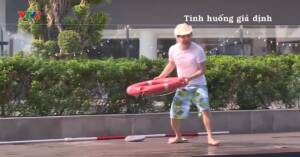
Throw buoys or floating objects.
Throw buoys or floating objects.
Throw it within reach of the victim so he can float on his own, then try to bring him to shore.
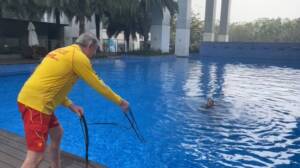
Throw the rope.
Expert Tony Coffey shows how to throw a rope.
Step on one end of the rope with one foot, roll the rope into a large coil, and throw the rope to the victim within arm’s reach so they can grab onto the rope. The rescuer then lowers the center of gravity and pulls the victim to shore.
3. Principles when having to go into the water to rescue.
Do not go into the water to rescue the victim if you do not know how to swim, have never learned and practiced rescue, or are in deep, dangerous water. In case you must go into the water to rescue the victim, please ensure the following principles:
Always remember that going into the water to save people is extremely dangerous. Only assist the victim when you can ensure your safety.
Do not touch the victim directly as they may cling to you and pull you into the water.
Approach from behind by swimming behind the victim or telling the victim to turn their back to you.
Here are some techniques to save victims when entering water.
Indirect touch.
Bring an intermediary object when entering the water, which can be a floating object such as a buoy, water can, or any other object so that the victim does not cling directly to you. You hold one end and the victim holds on to the other end. Then you slowly pull the victim to shore.
Pull directly to shore.
In case you cannot find an intermediate object for the victim to approach indirectly and decide to still go into the water to save the victim. In case you cannot find an intermediate object for the victim to approach indirectly and decide to still go into the water to save the victim.
Then grab the victim’s hair, collar, and nape of the neck and pull the victim in. At the same time, order the victim to lie on his back and kick his legs. At the same time, order the victim to lie on his back and kick his legs. This position helps you pull the victim to shore more easily and the victim also panics less.
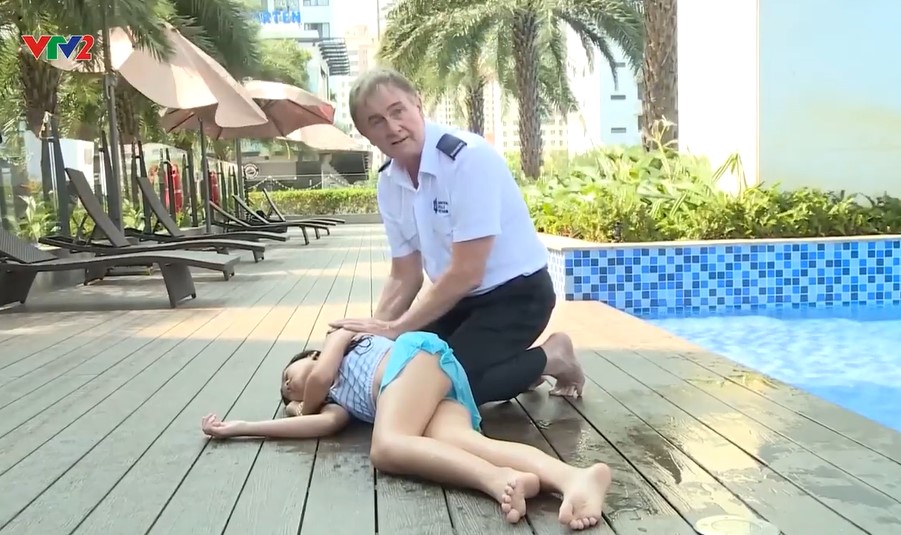
After successfully bringing the victim to shore. Give first aid to a drowning person. Please refer to the video below on how to provide first aid to drowning children, produced by SSVN Survival Skills in collaboration with VTV2.
The above instructions are referenced from documents of Surf Life Saving Services – Australia’s leading water rescue organization with more than 115 years of experience. Survival Skills SSVN is proud to be the exclusive partner of SLSS in Vietnam. You can learn these skills at SSVN Survival Skills‘ international standard First Aid training program at elearning.new.survivalskills.vn/en
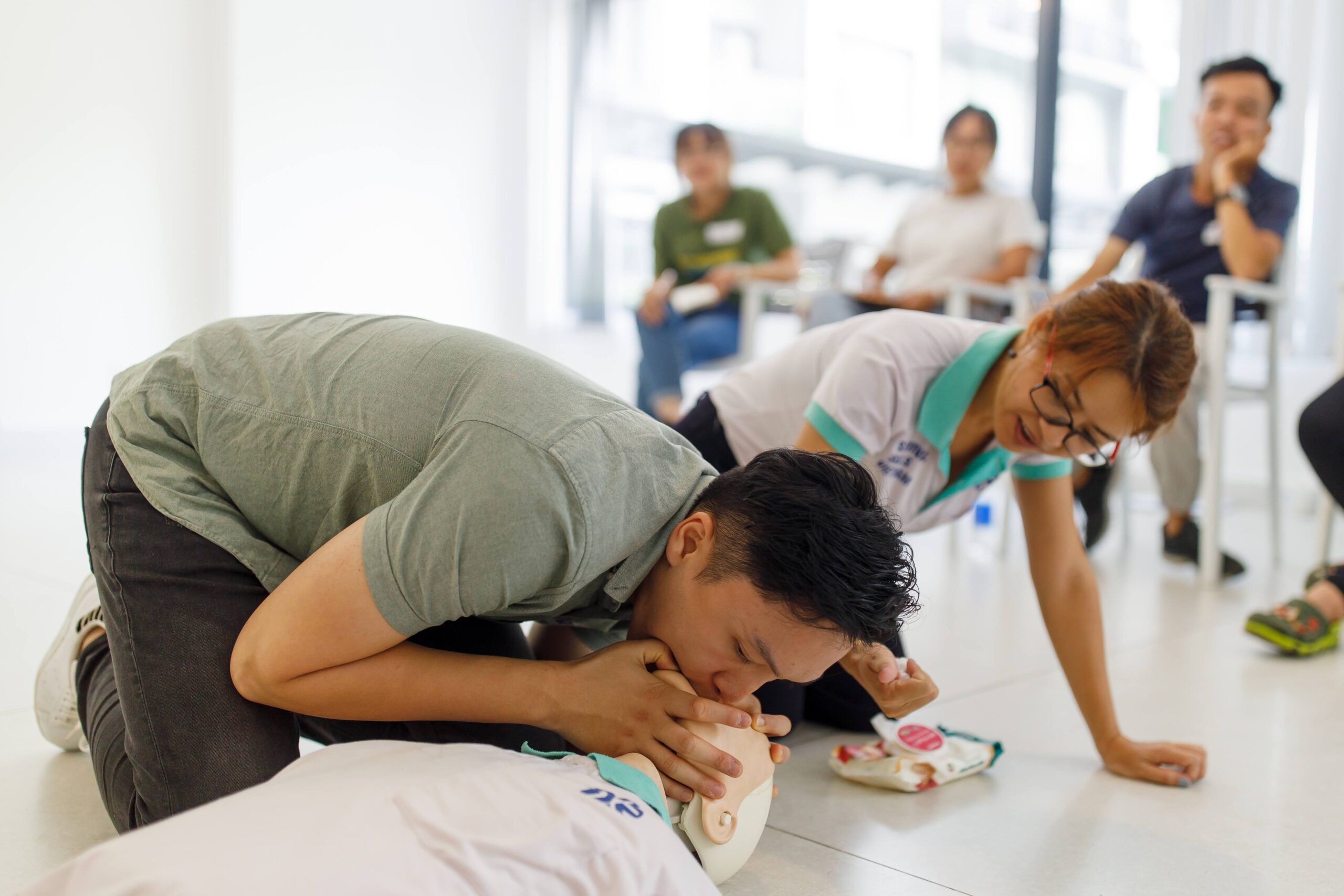
To perform rescue breathing (mouth-to-mouth resuscitation), the rescuer should kneel beside the victim's head, positioning themselves lower, and use their mouth to blow air into the victim's nose or mouth. It is preferable to blow through a specialized mask for rescue breaths to avoid the risk of disease transmission.
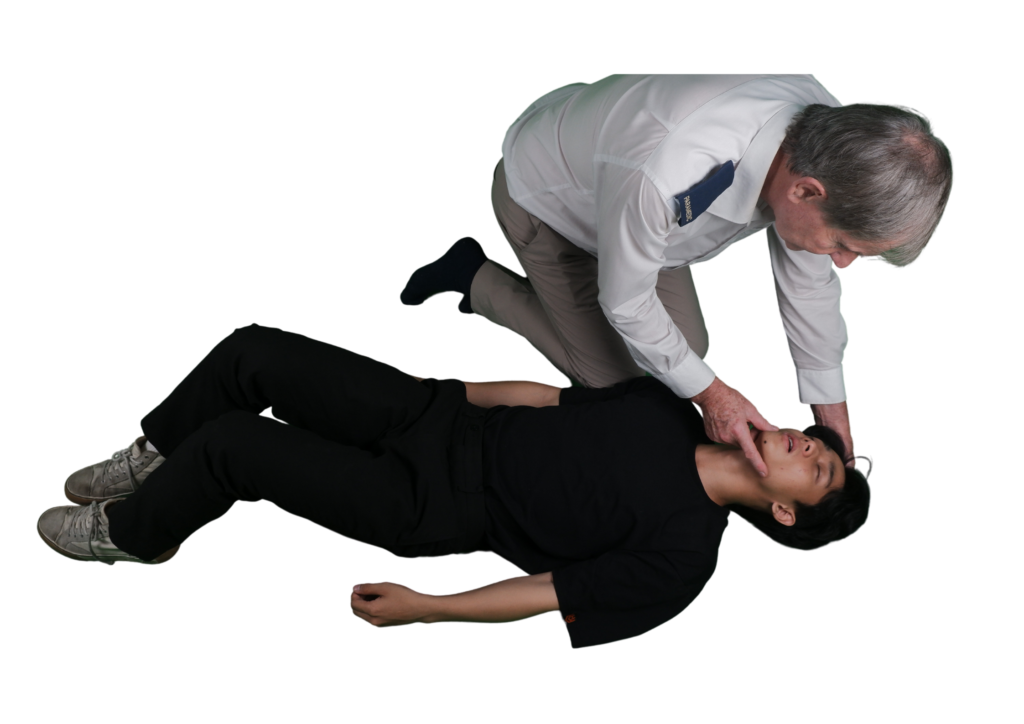
To blow air into the victim's lungs, the rescuer should lift the victim's chin and tilt their head back to open the airway. The rescuer should then gently blow into the victim's mouth or nose twice continuously, with each breath lasting no longer than 2 seconds.
When blowing into the victim's mouth, the rescuer should use two fingers to pinch the victim's nose, while keeping their own mouth open wide to cover both corners of the victim's mouth.
When choosing to blow into the victim's nose, the rescuer should close the victim's mouth tightly to prevent air from escaping.
Proper rescue breaths can be observed by a slight rise in the victim's chest, indicating air entering their lungs.
For infants, only use air from the rescuer's mouth (not air from their lungs) to blow gently since an infant's lungs are very small. The rescuer can cover both the infant's mouth and nose with their mouth simultaneously to prevent air from escaping when blowing.
Note: It is common for rescuers to become fatigued after 2 minutes of performing CPR. Therefore, it is necessary to call for help and take turns to ensure continuous CPR for the victim. CPR alone does not save lives; only proper and immediate CPR can help.
Note: The air we breathe typically contains 21% oxygen. The body requires 5% oxygen for each respiratory cycle -> exhaled breath still containing 16% oxygen.
Did you know how many Vietnamese people die or become disabled due to stroke every day? How many unfinished plans? How many dreams, losses, pain, and regrets for not being able to say goodbye to our loved ones who suddenly pass away?
With the current hot weather conditions, the risk of stroke is even higher, especially for older people, and strokes are increasingly occurring at a younger age, so we should not be too complacent.
Survival Skills SSVN's first aid practical class
There are many folk remedies that people use when they see someone having a stroke, such as pricking the fingertip, acupressure, cupping. These methods are completely wrong and only worsen the condition of the victim.
So how should we give first aid when we see someone having a stroke?
1. The first thing is to recognize the signs of stroke through the FAST rule for quick response.
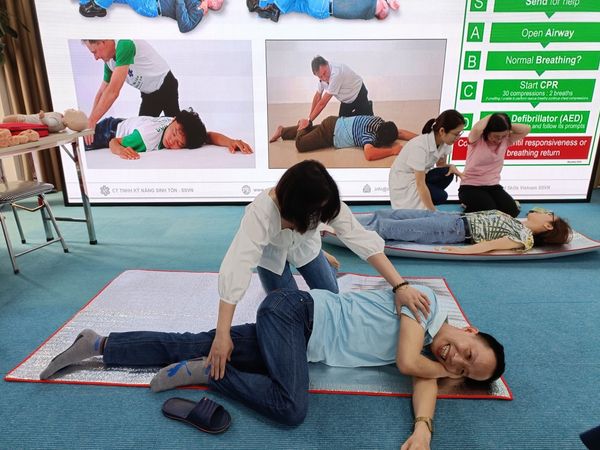
2. Position the victim in a safe inclined position to protect the airway. In unconscious patients, when lying on their back, the tongue can fall back into the throat, causing obstruction and blocking the airway.
3. Immediately call for emergency medical assistance and take the victim to the hospital.
Note: Regularly check the victim's airway. If the victim shows signs of unconsciousness, abnormal breathing, or stops breathing, lay the victim on their back on the floor. Then proceed with CPR immediately. Just a delay of 4 minutes can lead to brain death.
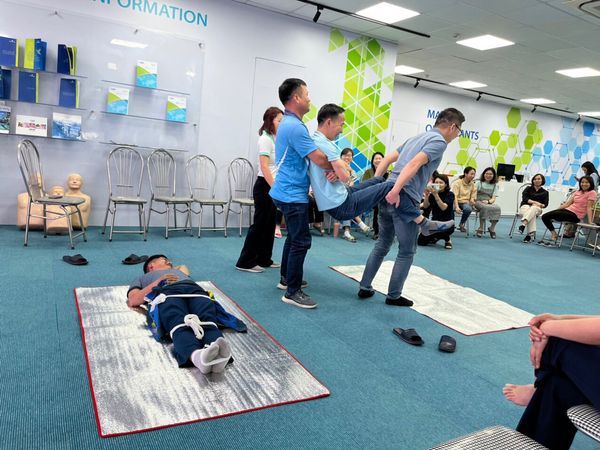
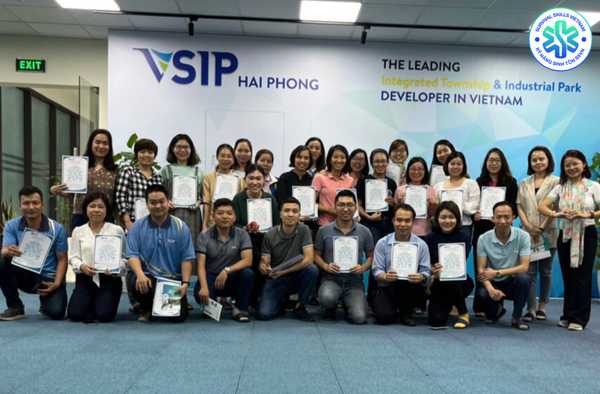
In the first aid skills training class for VSIP Hai Phong Industrial Park, SSVN gave in-depth instructions on CPR techniques and many other learning topics to handle fatal health accidents as quickly as possible. commonly encountered in life around us.
Participants received certificate after first aid training
SSVN hopes that enterprises will prioritize equipping their employees with first aid skills early on so that they can calmly handle health emergencies and accidents for themselves and their loved ones.
Movies while intended for entertainment purposes can sometimes convey misleading information that can be harmful to viewers. For example, when it comes to snake bites, movies may depict using a knife to cut the wound and suck out the venom. Is it correct?
Chị Diệu Thiện một học viên chương trình E-learning của Kỹ năng sinh tồn SSVN chia sẻ dở khóc dở cười vì những hiểu lầm tai hại về sơ cứu mà chị đã tình cơ xem trên phim ảnh.
I have always been an adventurous person, eager to learn and experience various things in different fields. So, while I was “having fun” like usual, I “picked up” the opportunity to approach a skill that is really highly applicable in daily life, which is first aid. I was quite “HALF-HALF”. Well, I know that first aid is good and necessary, but unfortunately, because I am interested in many things, from a young age until now, I have picked up quite a bit for myself (watching movies but learning first aid when bitten by a snake, learning “blood and bone” experiences from my father, mother, aunts, uncles, brothers, sisters, paternal and maternal siblings…, learning from organizations and activities I participated in), so I was quite lazy in approaching this time because I thought I HAD ENOUGH, especially when I was approached in a more passive position.
However, this time I still decided to diligently study first aid through the online course provided by Survival Skills Vietnam-SSVN. And indeed, my decision to study was wise because in this course, I was able to consolidate my knowledge of first aid from before in a more scientific and correct way, learn the causes of the disease in addition to first aid easily because the words and contexts used are very "everyday" and not at all as sophisticated as when you study medicine.
Moreover, I was taught by first aid expert Tony Coffey, who has more than 30 years of experience in this field in Australia and Vietnam. He corrected many misconceptions I had about first aid, especially when it came to treating snake bites.. Previously, I learned from movies that when bitten by a snake, you should use a sterilized knife to make a small incision at the bite site to extract the venom. But through this course, I learned that this is not the correct first aid approach (at this point, I realized how naive I had been to think that if something was shown in a movie, the producers must have done their research, so that method must be correct). Fortunately, I learned the correct method, which is to limit the movement of the bitten body part, not attempt to extract the venom by drawing blood. The snake venom actually resides in the lymphatic system, not the blood, so attempting to extract the venom would accelerate its spread into the body. Instead, using a bandage is recommended to immobilize the bitten area, slowing down the venom's movement. However, I must admit that I was still "lazy" throughout the learning process. Nevertheless, the SSVN course was perfect for lazy learners like me because the lessons were designed in concise modules of 5-10 minutes, each clearly linked to the next. The knowledge covered in previous videos would be briefly reviewed in subsequent videos. So, I could watch a little bit each day without investing too much time while still receiving complete and well-structured knowledge.
The above are my personal reflections on the importance of equipping ourselves with necessary skills, shared with the sole purpose of motivating readers to explore first aid, despite the "hesitation" caused by laziness and the perception that it is "too early" to learn. After all, if something should be done, it should be done, right?
Ms Thao Nguyen (HCMC) shared about a burn incidents that could have been less severe if someone in her Dubai tour knew first aid.
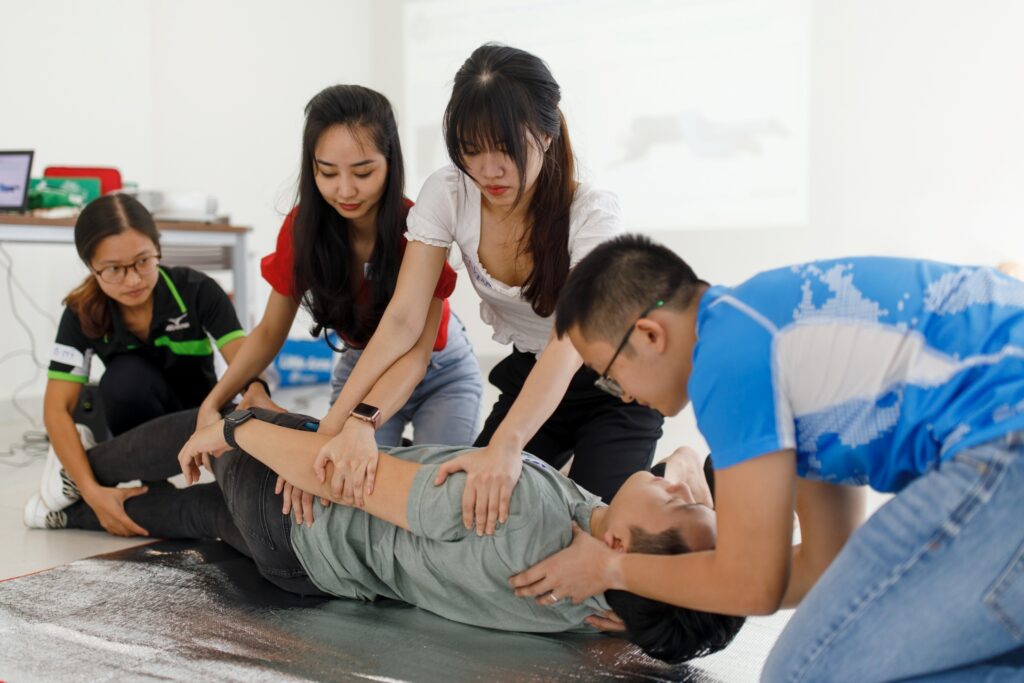
Ms. Thảo Nguyên and her friends practiced coordinating to position the suspected spinal injury victim for recovery.
This is a question that many people ask me, as well as the common responses: "the best thing to do is call an ambulance" or "it's best to wait for the doctor." However, there are many cases where the ambulance arrives too late, and the victim's condition is already critical or beyond saving. When a person stops breathing, they only have 4 minutes before brain death (irreversible), and 8 minutes before cardiac arrest. No ambulance can arrive in time during those critical moments. However, if we have some knowledge to support the victim, we can prolong their life while waiting for the ambulance. For example, last year my whole family went to Dubai, and unfortunately, just before going to the airport, my father suffered severe alcohol burns on his hands and feet (2/3 degree burns). The hotel staff and everyone around panicked, not knowing what to do. In the end, they applied toothpaste on the burns and wrapped them to buy time until we reached the airport. When we arrived at the airport, we sought medical assistance, and when they removed the bandages, the toothpaste and medical gauze had stuck to the flesh, making it difficult to remove. As a result, my father lost a significant amount of skin and experienced prolonged pain, taking a long time to recover. If someone in the group or I had some basic first aid knowledge, the situation would not have escalated to such a critical condition. n the past, whenever I had scrapes or cuts, I would apply iodine and gauze. Every time I changed the bandage, it would stick to the wound, causing delayed healing and leaving scars. However, if I didn't apply anything, the wounds would heal quickly and never leave scars. Or perhaps you have heard of someone who was normally healthy but died from a stroke. In reality, if someone with first aid knowledge were present while waiting for an ambulance, the victims might have had a chance to survive!
Ms. Thảo Nguyên and her friend in the class
My younger brother works part-time as a First Aid/CPR instructor in the U.S., teaching many students there. However, in Vietnam, people don't pay much attention to this issue. Before attending the course by Survival Skills Vietnam-SSVN, I never thought that the basic first aid knowledge I had been taught throughout my life could be so wrong. I learned first aid to be able to help primarily my loved ones and then others. Even in simple situations, when encountering an injured person, that someone doesn't know first aid moving the victim's body can unintentionally make their condition worse. Thanks to SSVN and CEO Ho Thai Binh for providing this valuable knowledge. SSVN organizes many free sessions for the community. If anyone is interested, you can visit SSVN's Facebook for more information.
Learning first aid is very important for yourself, your family and the community. However, it does not substitute for practice training under guidance of experts to make sure you handle real emergency with confidence and correct practices.